

Today, we are running health care like a body shop for cars. Fixing and reacting with a pill for everything, instead of fostering prevention, self-empowerment and lifestyle changes.
Are you taking a sleeping pill, a happy pill (that’s how some people call antidepressants) and a vitamin pill for your overall well-being? I am sure you chose good reasons to do so. On a grant scheme of things however, this culture of prescribing, producing and requesting a ‘pill for almost any- & everything in our lives’ without a clear connection & correlation to purpose & intent is becoming problematic.
Fundamentally, everyone agrees that health care today is built on the wrong incentives. If you incentivize action, pills & procedures, what you get is an expectation of action, pills & procedures. All it does is drive costs up. There is no incentive built in for doing “nothing”, for doing less or for changing behaviors; not for patients, not for providers, not for pharma, not for payers. However, in today’s world, resources are limited, and so we can no longer afford to waste dollars & energy.
Because resources are limited, actors are competing over bargaining power and are shifting cost burdens, and responsibility for the broken system, to each other. As a result, divides are deepening and costs are rising. Amid all of this complexity & uncertainty surrounding who holds the ultimate decision-making power, one thing is certain: the patient is always losing out.
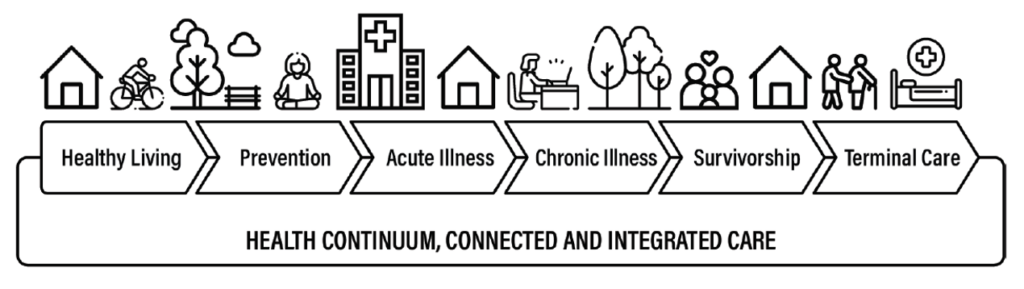
In light of the 3 megatrends of the future – aging, chronic illnesses & mental health – the individual health continuum is coming into focus. In an increasingly value-based world, health care is not only about a patient’s illness. It is also about preventing complications in the 1st place, protecting a person’s health & enabling optimal quality of life. In other words, it is about life as a whole.
Shifting our systems from a “fix & repair” to a “prevent & maintain” mindset will allow us to consider health as ONE continuity. Acknowledging that there is no real binary endpoint in a person’s life, other than birth & death, everything else being interconnected along the journey of life, health & illnesses.
It is not ONE actor’s responsibility alone however to drive this fundamental switch in the way we are looking at health. Providers alone, patients alone, payers alone, policy alone and pharma alone can’t fix that problem. It is only by a combined ‘top-down’ and ‘bottom-up’ approach that change is possible. In a coordinated Tango for Five.
Worldwide, there are many long-term initiatives endorsed by policy and picked up by grassroots initiatives on the provider, payer & patient level. For example, the NordicHealth 2030 policy strategy is putting equal investments with 5% of GDP on both the preventive end of the spectrum as well as on modernizing the care delivery system. Similarly, on the opposite side of the health continuum, terminal care accounts for up to 80% of a person’s lifetime spent on health care. In Colombia, the Programma Contigo is showcasing that by applying strict principles of value-based health care, the end-of-life experience can be significantly improved for patients & caregivers and cost can be significantly brought down.
Write us your experiences in your country and region of initiatives that foster, incentivize and reward a PREVENT culture instead of a FIXING culture.
Recent Comments